 Cowswap
 token swaps, market orders and limit orders
Cowswap connects token swaps and price-targeted orders to competing solvers, which find execution routes through CoW Protocol’s batch auctions. You specify the tokens and acceptable trading terms, then authorize an order with your wallet. Solvers can match compatible orders directly or use exchange liquidity to complete trades. Market orders seek prompt execution around a quote; limit orders wait for an acceptable price before expiry. Scheduled orders divide trading over time, while supported cross-chain swaps connect a source-chain trade to destination delivery. Fees, wallet permissions and route availability affect these choices. Signing an order authorizes execution under its conditions; it does not establish a completed trade.
Bottom line: A limit order controls your worst acceptable trading price, while execution also requires sufficient liquidity at a price that respects your limit and covers network costs.
The app, signed orders and settlement
The trading interface connects wallet balances and order controls to the protocol’s auctions and settlement conditions. Cowswap supplies the familiar token-selection form, quotes and order history. CoW Protocol handles the signed instructions and execution competition behind those controls. An intent describes an acceptable trade, including its tokens, amounts, recipient and expiry. This separation lets solvers search for execution paths while the signed terms continue to constrain what they can settle.
Limit orders add a price target, while scheduled orders add timing conditions. CoW Hooks attach contract calls before or after a swap, allowing integrations to connect trading with other supported actions. Cross-chain swaps use this extension to initiate bridging after the source-chain trade. Custom protocol integrations can expose capabilities beyond the main interface, so a protocol feature and a particular wallet’s available controls need separate consideration.
Market swaps and limit orders
Trading around a quote
A market order seeks execution near the available market price, with a signed boundary derived from the quote and slippage tolerance. Slippage tolerance sets the permitted adverse movement between quoting and execution. It does not promise the displayed quote will remain available. Market orders use fill-or-kill execution: a settlement must fill the complete order or leave it unfilled. Better execution can improve the proceeds, while insufficient liquidity or a price outside the signed boundary prevents a fill.
Waiting for a target price
A sell limit sets the minimum acceptable price, and a buy limit sets the maximum acceptable purchase price. The order also has an expiry. Reaching the displayed target alone may not produce execution because the available trade must cover network costs while respecting the limit. The open-order display’s execution threshold reflects this difference.
Limit orders default to partial fills, although the interface also supports fill-or-kill. Partial execution allows fills across multiple auctions. A small remainder may stay unfilled when its value cannot economically cover another settlement.
Peer matching alongside exchange liquidity
Compatible orders can exchange assets directly through a Coincidence of Wants, while unmatched volume can use external liquidity. Direct matching avoids liquidity-provider fees on the matched volume and reduces interactions with exchange pools. Solvers can combine this matching with automated market makers, exchange aggregators and private liquidity. A trade therefore does not require an opposing user order for its entire amount. The auction evaluates execution proposals under its rules, and the winning settlement can combine several liquidity sources.
Trading costs and the amount received
Gasless order submission moves settlement costs into the trade’s economics, while approvals and certain wallet actions can still require network transactions. For an ordinary signed ERC-20 order, solvers pay settlement gas and recover its cost through the sell token. Protocol charges can also depend on traded volume or price improvement. These costs affect the trading terms, so the amount receivable after applicable charges matters when comparing quotes. A fee percentage alone does not describe the complete exchange outcome.
Network conditions, order size and available liquidity change the economics of execution. Batching can reduce costs per trade, but it does not establish one fixed fee for every order. An unfilled signed order does not incur a settlement fee. A separate approval or wrapping transaction still consumes gas even if the intended trade never completes. Native-token order placement has its own upfront cost, and cross-chain quotes also include the bridge provider’s charge.
A minimum return across different liquidity routes
For a full sell limit order, the signed minimum determines which proceeds are acceptable across different execution routes. In this hypothetical example, an order offers 148 units of a sell token for at least 222 units of a buy token before its chosen expiry. The minimum rate is 222 divided by 148, or 1.5 buy-token units per sell-token unit, after trading fees.
A proposed full settlement returning 228 buy-token units after fees clears the minimum by 6 units. Direct matching, external liquidity or both can supply those proceeds under the same signed price condition.
This proposal meets the price condition; actual execution also requires a valid order, sufficient balance and the necessary spending permission. Proceeds below 222 units would violate this full order’s minimum. Changing the minimum changes the acceptable proposals, while expiry limits when the order can execute.
Scheduled trading with TWAP
A time-weighted average price order, or TWAP, divides a trade into smaller parts scheduled over a chosen duration. Price protection constrains execution when the market moves adversely, so the schedule does not guarantee every part will fill. Dividing a trade can reduce its immediate price impact, although later prices can be worse. TWAP support expanded from Safe wallets to externally owned accounts, the ordinary wallets controlled by private keys, on September 30, 2026. Each part needs economical execution, making network-specific minimum sizes relevant.
Network access and cross-chain delivery
Supported networks and token contracts
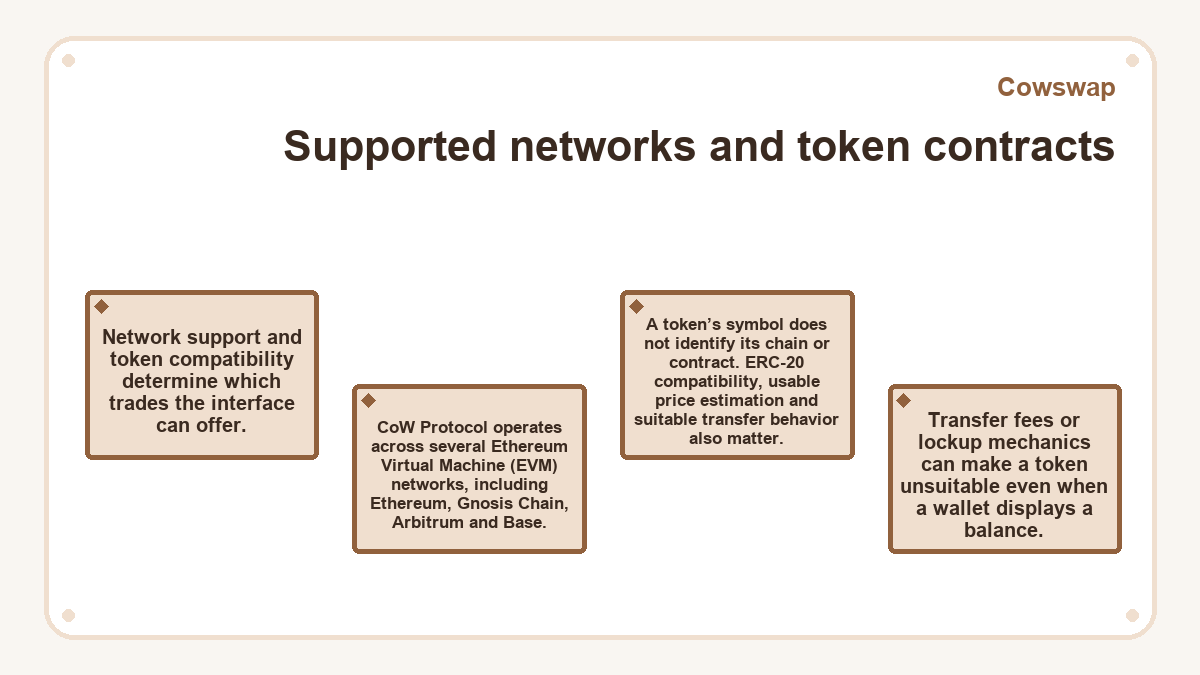
Network support and token compatibility determine which trades the interface can offer. CoW Protocol operates across several Ethereum Virtual Machine (EVM) networks, including Ethereum, Gnosis Chain, Arbitrum and Base. A token’s symbol does not identify its chain or contract. ERC-20 compatibility, usable price estimation and suitable transfer behavior also matter. Transfer fees or lockup mechanics can make a token unsuitable even when a wallet displays a balance.
The swap and bridge relationship
Cross-chain swaps require different source and destination tokens; available destinations depend on the source token and bridge provider. The source-chain swap precedes the bridge deposit, which uses an Account Proxy, also called CoW Shed. The quote distinguishes the swap minimum from the destination minimum after bridge costs. Source settlement does not establish destination receipt. After the bridge deposit, cancellation is unavailable; completion or refund follows the provider’s policy. A refund can return to the Account Proxy and require recovery to the wallet.
Wallet permissions and native-token routes
Connections and spending authority
Wallet connection, token approval and order authorization grant different permissions, so connecting a wallet alone does not authorize a trade. The interface supports browser wallets, mobile connections through WalletConnect and Safe. A compatible connection must also support the signing method the selected feature requires.
ERC-20 approvals allow the vault relayer to spend the selected token. The interface supports approving the intended trading amount, reducing the allowance compared with unlimited approval. Some tokens support signature-based approvals for compatible wallets. The gasless approval path excludes smart contract wallets. An approval authorizes its spender to use the token; an order signature fixes the recipient and trading terms.
Wrapping before trading
Native ETH and wrapped ETH, or WETH, follow different authorization paths. WETH supports ERC-20 allowances, so it can enter the ordinary signed-order flow. Wrapping ETH requires an on-chain transaction and gas. A wrapped balance can support subsequent orders without repeating the wrapping transaction for each trade.
Native-token order placement
The Eth-flow contract combines native-token wrapping and order placement in one on-chain transaction. That transaction places an order; settlement still needs to occur afterward. The route requires upfront native-token gas, which a failed order does not refund. Failed orders can return the deposited ETH through the refund mechanism.
Eth-flow supports swaps and excludes smart contract wallets in the main interface. Safe’s app can bundle wrapping, any necessary approval and order placement, providing a different route for native-token trading.
What does MEV protection cover?
Protection against maximal extractable value (MEV) targets trading losses from front-running and sandwich attacks around exchange-pool swaps. Signed intents let solvers organize settlement without users broadcasting individual swap transactions. Peer matching avoids pool exposure for the matched volume. Within a settlement solution, orders trading the same tokens in the same direction share clearing prices, with an exception for additional hook gas costs. These mechanisms restrict opportunities to exploit the ordering of user trades.
The settlement contract enforces each order’s signed limit price. This protection follows the terms the wallet authorizes. An excessively permissive minimum can still allow an unfavorable exchange, and an incorrect recipient directs proceeds to the wrong address. Liquidity and changing market conditions can also prevent execution. The amount and destination recorded in the signed order define the trade the contract may complete.
Cowswap - common questions
Is canceling a signed order always free?
Off-chain cancellation of an ordinary signed order is free, while on-chain cancellation requires gas. Neither method guarantees the request will beat a settlement already in progress. Eth-flow orders require on-chain cancellation. Cross-chain cancellation also has a boundary: once the swap has executed and the bridge deposit has occurred, the bridge transfer cannot be canceled.
Does editing a submitted market swap change its original signature?
A submitted market order’s signed parameters cannot change in place. Different tokens, amounts or recipient details require canceling the existing order and authorizing a replacement. A cancellation request can race with settlement, so it does not itself establish the original order has stopped. The new signature authorizes the replacement’s terms.
Can several limit orders draw on the same wallet balance?
Several outstanding limit orders can reference the same wallet balance, but execution requires sufficient funds. Placing them does not multiply the available tokens. A fill or another wallet transfer can reduce the balance available to remaining orders. Their price targets and validity periods still apply, and partial execution can leave some orders unfinished.
Where can I inspect older trades and partial fills?
CoW Explorer shows order details and individual fills beyond the interface’s recent activity view. It supports searches by order identifier, wallet address and settlement transaction hash. A partially filled order can span several batches, with separate fills contributing to its executed amounts and average price. An order identifier alone does not prove settlement.
Which hardware wallets can connect to Cowswap?
Supported hardware-wallet options include Trezor and Ledger, with connection through supported integrations. A browser wallet can provide the connection while the hardware device authorizes the signature. Compatibility depends on the connection and signing method, so hardware-wallet support does not imply every advanced order type follows the same authorization path.
Are ENS names accepted for a cross-chain recipient?
The cross-chain custom-recipient field requires a full wallet address and does not support ENS names. The connected wallet address is the default recipient. A custom recipient must be suitable for the destination network, so its address belongs in the destination-recipient field.
Why is a token missing from the selector when my wallet holds it?
The interface’s default token lists can omit tokens your wallet holds. Importing a custom token can make it available in the selector, but liquidity and protocol compatibility still determine whether it can trade. The contract address and selected network identify the asset; matching a familiar symbol does not establish they are the intended token.
What can Telegram notifications report about my orders?
Telegram alerts can report executed swaps, limit-order fills and expirations; the September 2026 rollout also included Safe TWAP notifications. A partial-fill alert describes an executed portion of an order. An expiration alert does not imply the full intended trade completed, since an expiring order can already have partial fills.